'/%3E%3C/svg%3E)

'/%3E%3C/svg%3E)

How to use this document
Welcome to the Gamification Strategies document. This section provides a detailed explanation of how to navigate and use the PDF version of the document effectively. It also highlights unique features, such as colour-coded chapters, and offers guidance for maximising your experience.
Offline (PDF) instructions
This guide is structured into two main sections: a theoretical framework outlining the principles of gamification in adult education, followed by five practical game scenarios designed to enhance engagement in urban gardening. The table of contents is located at the start of the document and is hyperlinked, allowing you to click on any chapter or scenario title to navigate directly to that section. To find specific keywords, concepts, or facilitator guidelines quickly, you can use your document reader’s built-in search function (typically Ctrl+F on Windows and ⌘+F on macOS). The primary advantage of this offline version is its reliability and accessibility, ensuring you can use it to prepare for and deliver workshops in any setting, even in locations without a stable internet connection. The offline version (PDF) also allows for printing; however, for sustainability reasons, we highly recommend printing this document sparingly, perhaps limiting it to the specific game materials or “printable rewards” mentioned in the scenarios.
Online instructions
For a more interactive experience, the online version of these Gamification Strategies is available on the InclusiGardens project website. The online platform offers enhanced navigation, making it easy to access the hyperlinks connecting the game scenarios directly to the relevant e-Toolkit modules and e-Cookbook recipes. It also includes accessibility features—such as options to adjust text size, contrast, and screen reader compatibility—to better accommodate all adult learners. Furthermore, external links to research sources and the digital feedback form are fully functional in the online version, providing a connected and integrated experience for both educators and participants.
Gamification strategies
1. Introduction
The InclusiGardens project empowers adult learners to engage in sustainable urban micro-gardening through interconnected tools: the e-Toolkit, the e-Cookbook, the Gamification Strategies (this guide), and finally the upcoming Curriculum. All current and future project results will be available on the InclusiGardens website in English, Slovenian, Croatian and Dutch allowing for a multilingual and multimodal experience for all learners.
After developing knowledge materials (the e-Toolkit) and a hands-on application (the e-Cookbook), this next step introduces a motivational and experiential layer: learning through play.
The gamification strategies build on the insight that motivation is as essential as information. For many adults, the step from reading about gardening to actually starting can feel large. Gamification bridges that gap by turning sustainable practices into interactive, achievable missions that are both social and rewarding.
The goal is not to make gardening a competition, but to use play to nurture consistency, curiosity, and connection – values that sustain long-term behavioral change.
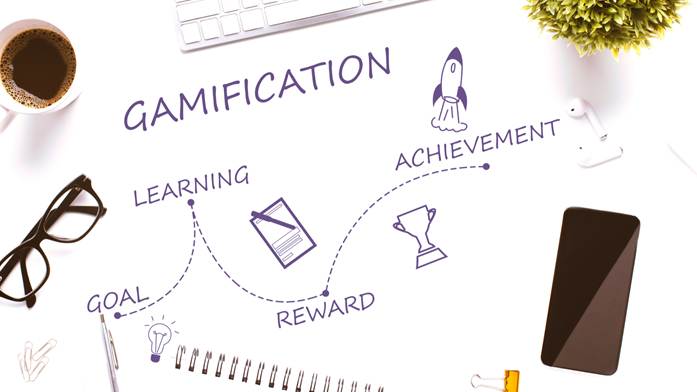
Illustration of gamification in adult education by O’Donnell, 2022
2. Defining gamification & application
2.1. Gamification
Gamification refers to the use of game-like elements, principles, and motivational techniques in contexts that are not games, such as education, health, or community engagement. Instead of turning a learning process into a full game, gamification takes selected components that make games engaging – for example challenges, feedback, progress indicators, rewards, storytelling, collaboration, and curiosity triggers – and integrates them into a learning experience.
For adult learners, gamification works particularly well because it transforms abstract information into concrete, interactive steps. It helps learners maintain momentum by offering small wins, clear goals, and visible progress. This is valuable in adult education, where learners often juggle many responsibilities and benefit from learning experiences that feel purposeful, manageable, and immediately applicable.
Gamification also supports different forms of motivation. It can stimulate intrinsic motivation by sparking curiosity, creativity, or the joy of seeing something grow. At the same time, it can reinforce extrinsic motivation through badges, milestones, or community recognition. In a well-designed system, these two types of motivation work together: adults stay engaged not because they are “playing a game,” but because the game elements provide structure, encouragement, and a sense of achievement.
In the context of sustainability and urban micro-gardening, gamification is particularly powerful. Gardening already contains natural cycles of reward: planting, nurturing, failing, trying again, and eventually enjoying the results. Gamification can amplify these cycles by helping learners stay consistent, connect with others, and translate knowledge into hands-on action. When applied thoughtfully, gamification lowers barriers to participation, supports learners with different digital skills, and creates a learning environment that is inclusive, empowering, and rooted in real-life impact.
2.2. Serious games
Serious gamesare purpose-driven games designed primarily for learning, reflection, or behavior change rather than entertainment alone. They use interactive game worlds, decision-making, and simulated systems to help players understand complex topics in a way that feels engaging and hands-on. Instead of presenting information passively, serious games invite learners to experience consequences, explore alternatives, and practice new skills in a low-risk environment.
For sustainability topics, serious games are especially effective because they allow players to experiment with real ecological or social systems. EVRgreen Studio’s Forest Garden Game is a clear example: players design and manage a regenerative food forest, learning how elements such as biodiversity, soil health, and companion planting influence each other. By navigating this living system, players gain insights that would be hard to grasp through text alone.
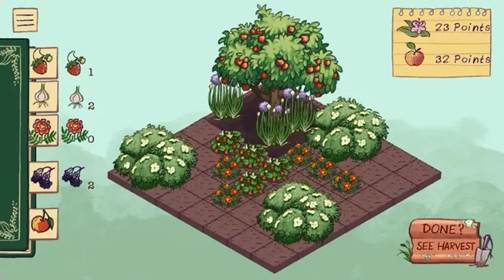
Screenshot of Forest Garden Game by EVRgreen Studio, 2024
A second relevant example comes from AllOne’s Virtual Garden, an in-browser interactive game. In this experience, learners care for a digital garden that mirrors real gardening tasks, such as watering, pruning, dividing responsibilities, or preparing materials before an in-person gardening day. The virtual garden is deliberately designed to complement offline action: what users practise, plan, or coordinate online directly supports what they will later do in a physical garden. This blend of digital preparation and real-world activity demonstrates how serious games can bridge online learning with hands-on sustainability, making the learning process smoother, more accessible, and more motivating.
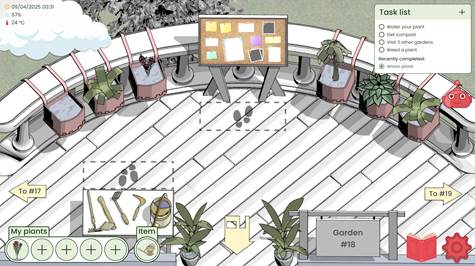
Screenshot of Virtual Garden by AllOne, 2024
In this way, serious games make learning immersive and memorable – turning abstract principles into actionable understanding.
2.3. Application for adult education
Even though this document will closely examine the application of gamification and gamified content in the project InclusiGardens approaching topics of sustainability via urban micro gardens, we invite you to also explore other examples of applying gamification in the teaching and learning processes in adult education. For example, the EPALE (Electronic Platform for Adult Learning in Europe) offers many great programs.
The value of gamification in adult education has been widely recognised within the Erasmus+ community. Over the past years, many projects have demonstrated how playful and interactive approaches can strengthen motivation, digital inclusion, and long-term learning.
Erasmus+ projects such as the Power of Gamification supported educators in integrating simple game mechanics into non-formal learning. Resources like the Gamification and Adult Literacy report were created for tutors and resource developers looking for ways of increasing adult engagement in literacy learning offering best practices for incorporating gamification and game elements into adult literacy education. Similarly, the Games4You project explored how game-inspired methods can enhance community learning and social inclusion across different European contexts. Find more Erasmus+ projects related to gamification in the Appendix.
Together, these projects highlight that gamification is not an isolated trend but a growing and trusted educational approach across Erasmus+, offering evidence that playful learning can meaningfully support adults in developing new skills, sustaining engagement, and applying knowledge in real life.
2.4. Application for micro-gardening
In the context of sustainability and urban micro-gardening, gamification is particularly powerful. Gardening already contains natural cycles of reward: planting, nurturing, failing, trying again, and eventually enjoying the results. Gamification can amplify these cycles by helping learners stay consistent, connect with others, and translate knowledge into hands-on action. When applied thoughtfully, gamification lowers barriers to participation, supports learners with different digital skills, and creates a learning environment that is inclusive, empowering, and rooted in real-life impact.
Gamification also helps translate the e-Toolkit’s knowledge and the e-Cookbook’s recipes into small, doable actions: a challenge might invite learners to “sow one edible plant this week,” “share your compost tip,” or “cook a seasonal meal with your harvest.”
This combination of digital reminders and physical actions helps transform passive awareness into active participation.
InclusiGardens embraces playful learning that empowers rather than tests. Through humor, storytelling, and visual feedback, sustainability becomes approachable and inclusive rather than moralizing or abstract.
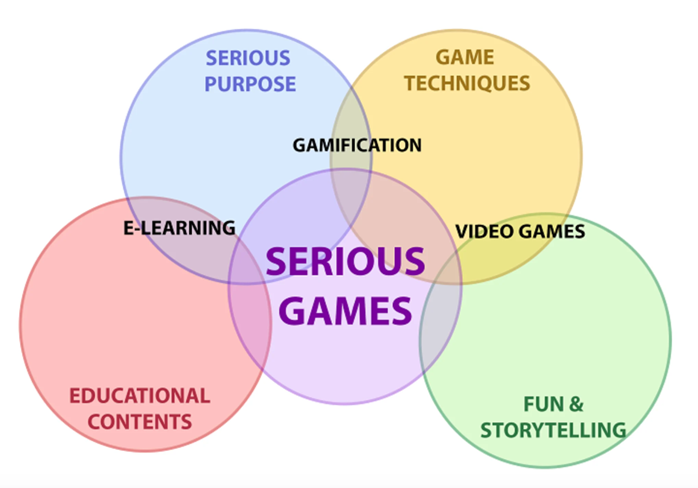
The context of serious games by Bates, 2022
3. Co-creation
The gamification strategies were partly developed through participatory design – often called co-creation. Co-creation is short for collaborative creation and stands for developing ideas, tools, or solutions together with the people who will ultimately use them, rather than designing for them from a distance.
In practice, this involves bringing learners, experts, and stakeholders into the design process through workshops, focus groups, testing sessions, and shared decision-making, ensuring the final outcome truly reflects their needs, experiences, and motivations.
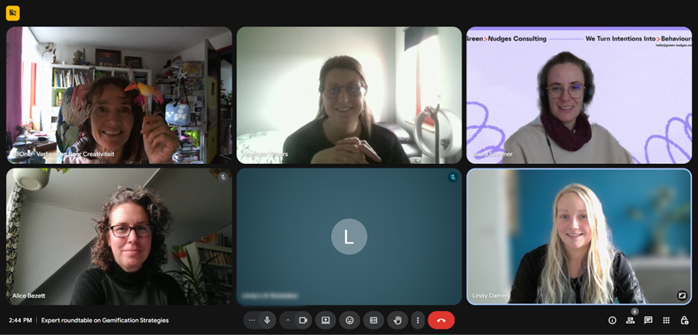
Photo of expert roundtable organised online by EVRgreen Studio, 2025
As we provided the tentative framework and baseline for the gamification strategies, they were affirmed and upgraded with insights from an expert roundtable and focus groups across partner countries.
Experts in behavioral science, community education, and green innovation sat at the roundtable to share their knowledge on specific topics and questions we prepared beforehand. This way, we learned how they are already collaborating with learners to explore what truly motivates adults to engage with sustainability and gardening.
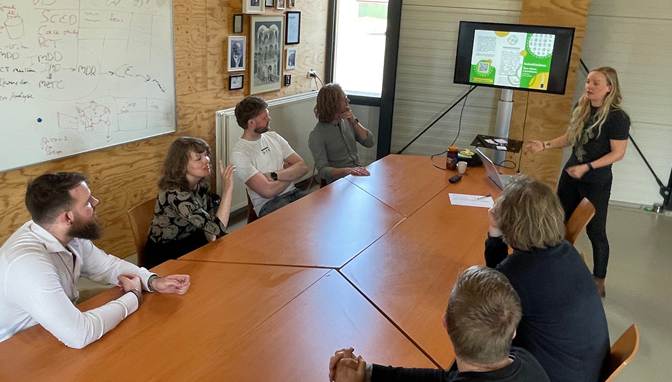
Photo of focus group organised by EVRgreen Studio, 2025
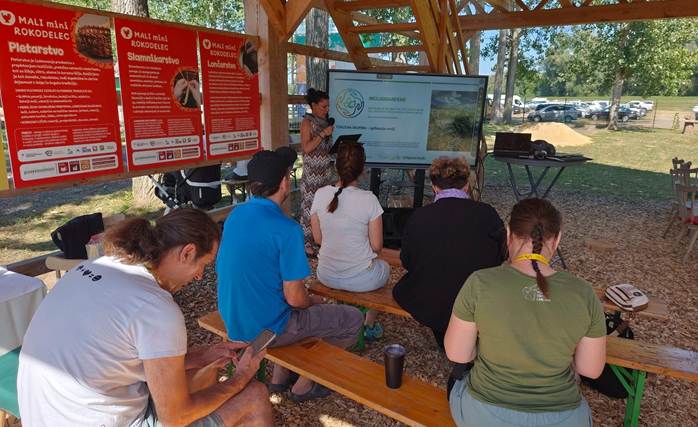
Photo of focus group organised by DPS, 2025
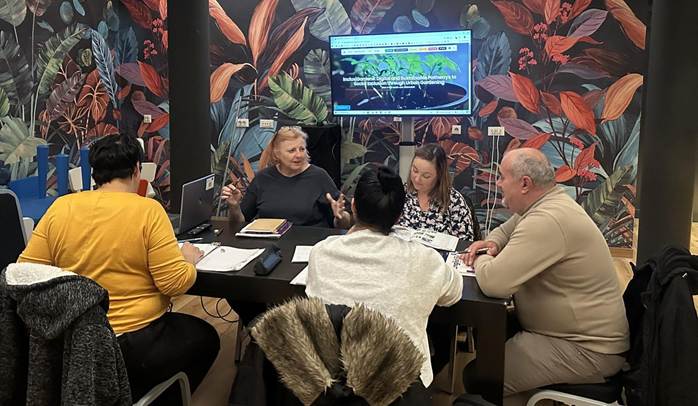
Photo of focus group organised by POU Čakovec, 2025
4. Principles for effective gamification
4.1. Motivation & purpose
Motivation through purpose:Adults are most engaged when an activity feels meaningful and connected to their everyday life. They value learning experiences that offer personal relevance, emotional connection, or visible impact on their surroundings. Gamified elements work best when they reinforce a sense of purpose rather than focusing on points or competition.
Real-world rewards matter more than badges: Participants are motivated by tangible outcomes – such as seeing a plant grow, cooking with their own harvest, or contributing to a shared community effort. These real-life rewards create a deep sense of accomplishment that digital badges cannot replicate. When learners feel that their actions have concrete value, their engagement naturally increases.
Embracing learning by failure: Adults appreciate when a learning tool acknowledges the real-world nature of gardening, where mistakes are inevitable. A plant that dies or compost that goes wrong becomes a learning moment rather than a setback. Framing failure as part of the growth process builds confidence, resilience, and a more authentic learning journey.
4.2. Community & collaboration
Friendly collaboration feels safer than anonymous competition: Adults prefer working together with peers they know or trust, rather than competing with strangers. Collaborative challenges create a sense of shared achievement and encourage mutual support. This fosters a safe learning environment where everyone feels comfortable participating.
Community and fun: Playfulness helps break down barriers and make sustainability topics feel lighter and more approachable. By incorporating creativity, humor, and shared goals, the learning experience becomes more enjoyable and socially engaging. This strengthens group cohesion and encourages ongoing participation.
Inclusion through exchange: Participants value opportunities to exchange knowledge, skills, or resources — especially between generations or cultural groups. Pairing young learners with older residents or newcomers promotes mutual learning and builds community resilience. These kinds of exchanges create meaningful connections that go far beyond the digital environment.
4.3. Accessibility & simplicity
Accessibility: Visual communication, icons, and intuitive missions make the gamified tool usable for adults with varying literacy, language, or digital skills. Reducing text and offering clear visual cues helps prevent overwhelm and supports learners who prefer hands-on or visual approaches. Accessibility also ensures inclusivity across different age groups and learning backgrounds.
Simplicity first: Learners consistently emphasised the importance of a tool that is easy to start and understand. A clean interface and simple actions prevent drop-off and lower the barrier to participation. When learners feel capable from the very first interaction, they are more likely to return.
4.4. Real life integration
Digital–physical integration: Participants want online activities that directly encourage physical gardening actions. When digital prompts lead to real behaviour – watering, sowing, composting, or visiting a local garden – learning becomes embodied and memorable. This integration bridges the gap between knowing and doing.
Fixed rhythm and rewards: Regular prompts, weekly routines, and small rewards (such as recipes, seasonal tips, or progress visuals) help sustain engagement over time. Rhythm creates a sense of reliability and motivates adults to build habits rather than one-off actions. Rewards tied to tangible progress reinforce the connection between effort and impact.
4.5. Long-term engagement
Reminders and humor help maintain momentum: Lighthearted notifications can encourage learners without feeling pushy or stressful. Humor makes sustainability feel more joyful, while reminders support those juggling busy schedules. Together, they help maintain a healthy rhythm of engagement.
Continuity: Seasonal changes, new missions, and evolving challenges keep the learning experience dynamic. By reflecting the natural cycles of gardening, the tool encourages learners to return throughout the year. This long-term engagement reinforces sustainable habits and deepens participants’ connection to their environment.
These principles confirm that gamification can help transform the InclusiGardens materials into living, community-driven learning experiences.
The co-creation with different experts and audiences ensured that the strategies reflect real user needs, different digital literacy levels, and local social contexts. The outcome is a shared framework that connects game mechanics with tangible, real-world gardening experiences – making InclusiGardens a bridge between learning online and acting offline.
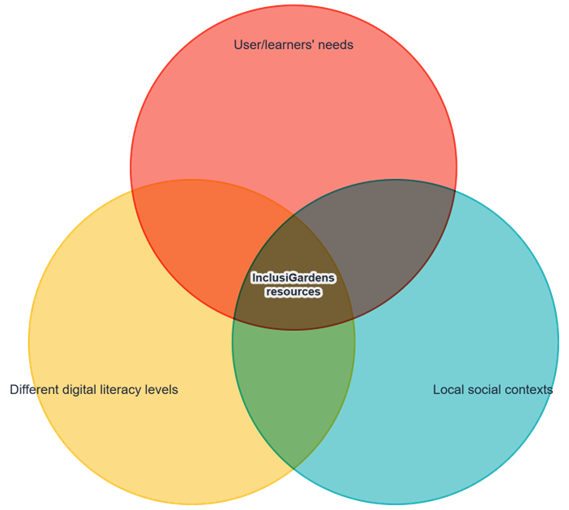
Visualization of the inclusive approach in creation of the InclusiGardens resources, 2025
5. Learning outcomes
Gamification supports the learning outcomes defined in the e-Toolkit:
- Strengthening environmental literacy through practice: Environmental literacy grows most effectively when learners can immediately apply what they discover. Gamified challenges – such as observing pollinators, planting seasonal herbs, or experimenting with compost – turn abstract knowledge from the e-Toolkit into hands-on experience. By repeatedly engaging with real plants, soil, and local biodiversity, learners develop a deeper, more intuitive understanding of ecological processes and sustainable choices.
- Building self-confidence and routine in sustainable habits: Many adults hesitate to start gardening because they fear doing it “wrong” or don’t know where to begin. Gamified tasks help break this barrier by offering small, achievable steps that gradually build confidence. Streaks, progress tracking, and gentle reminders support learners in building a routine – showing that regular care, even in small doses, leads to meaningful progress over time.
- Encouraging collaboration and shared care within communities: Sustainable behaviour becomes stronger and more resilient when shared. Gamified features that promote collaboration – such as joint missions, community gardens, or shared virtual spaces – help learners experience gardening as a collective effort. This not only strengthens social bonds but also distributes responsibility, making sustainable habits easier to maintain and more enjoyable to practise.
- Aligning game mechanics with learning outcomes: Every game mechanic within the InclusiGardens concept is intentionally connected to a learning purpose. Streaks support routine-building, shared missions foster collaboration, observational tasks strengthen environmental literacy, and visual progress indicators boost confidence and motivation. By aligning fun elements with educational goals, the gamification strategy ensures that play and learning reinforce one another, creating a seamless bridge between digital engagement and real-world sustainable action.
6. Design principles for the game scenarios
From the combined insights of the InclusiGardens partners, experts and participants, five guiding principles define the game design process:
6.1. Connect online & offline
A core principle is that every digital interaction should motivate or mirror a real-world gardening action. Digital prompts, missions, or reminders only become meaningful when they lead to hands-on experiences such as watering, sowing, observing biodiversity, or caring for soil. This bridging of environments helps learners turn knowledge into behaviour, strengthening sustainable habits over time. It also ensures that the digital tool remains grounded in the physical, sensory richness of gardening – something that is especially important for adult learners. By constantly linking the two worlds, the gamification strategy avoids becoming a purely virtual experience and instead supports practical, embodied learning.
6.2. Foster collaboration & shared achievement
Sustainability flourishes through cooperation, and the game scenarios reflect this by emphasising collective challenges over individual competition. When learners work together toward shared goals – whether growing herbs for a community meal or maintaining a virtual garden patch – they feel a sense of belonging and shared responsibility. This approach creates a safe and motivating space, especially for adults who may feel hesitant about their gardening skills or digital confidence. Collaborative design also encourages cross-generational or cross-cultural exchange, tapping into the knowledge and strengths of diverse groups. As a result, the game becomes a tool for community-building as much as for learning.
6.3. Visualize impact clearly & simply
Visual feedback is essential for adult learners, especially when dealing with gradual processes like plant growth or compost development. Simple visuals – such as growth bars, blooming icons, biodiversity cards, or CO₂ savings meters – help learners quickly understand the results of their actions. These visual cues create a sense of progress and reward, reinforcing consistency without relying on competitive points systems. They also make abstract ecological concepts more tangible, allowing learners to see the environmental value of their choices. Ultimately, visual impact indicators support motivation, reflection, and long-term engagement.
6.4. Make it inclusive & accessible
Inclusivity is central to the InclusiGardens approach, and the design must reflect this through clear language, intuitive navigation, and culturally adaptable content. Using icons, visuals, and short missions ensures accessibility for adults with different literacy levels, language backgrounds, or digital skills. The learning tool should accommodate slower learning paces and offer flexible entry points, making users feel welcomed regardless of prior experience. Cultural adaptability is equally important – examples, plants, and challenges should resonate with different European contexts and urban realities. By prioritising accessibility at every level, the gamification scenarios can empower a wide range of learners, including those often excluded from digital education.
6.5. Celebrate curiosity & care
The scenarios are designed to encourage exploration, experimentation, and a sense of wonder – all of which are essential in both gardening and adult learning. Playful mechanics invite learners to try new things without fear of failure, transforming mistakes into meaningful learning moments. This supports confidence-building, especially for adults who may feel uncertain about gardening tasks or overwhelmed by sustainability topics. A focus on care – for plants, soil, biodiversity, and each other – aligns with the emotional foundations of sustainable behaviour. By celebrating curiosity and care, the gamification strategy cultivates intrinsic motivation, making the learning journey enjoyable and personally meaningful.
Game scenarios
7. Introducing the game scenarios
All of the insights above guided the design principles for the five upcoming game scenarios. The five scenarios described in the next section will demonstrate how these principles can be implemented and tested. Each scenario follows a unified structure that outlines its core elements: general information, pedagogical framework, narrative, gameplay mechanics, inclusion strategy, and facilitator guidelines.
Together, they form the practical outcome of the gamification strategies: a Gamification Strategies book (this document), and a set of 5 interactive scenario prototypes to be explored with adult learners in partner countries. Each scenario is rooted in the resources created as part of the Erasmus+ project InclusiGardens which followed the co-creation design steps. You are invited to explore them, be inspired by them, copy them or adapt them and use them with your learners.
Each scenario explores a distinct motivational pathway: nurturing, cooperation, exchange, discovery, or storytelling, all grounded in InclusiGardens’ goal: to make sustainable urban gardening engaging, inclusive, and joyful.
7.1. Game scenario 1: The Green Balcony
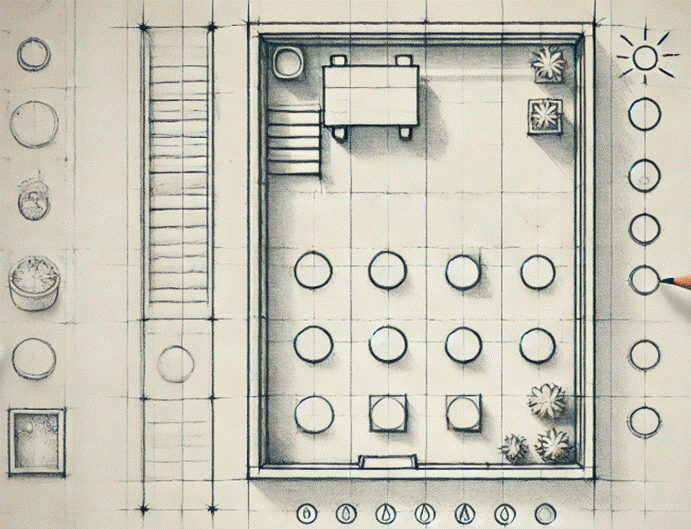
Early concept sketch for Scenario 1: The Green Balcony generated with DALL·E, edited with Adobe Photoshop
Description
The Green Balcony introduces learners to the very first steps of urban micro-gardening by helping them build confidence with the simplest plant-care skills. It turns a small, grey balcony into a playful learning space where users unlock plants by demonstrating essential knowledge about light, water, and soil. This scenario is designed as a gentle, motivating starting point for beginners who want to grow their first herbs or vegetables without financial risk or overwhelm.
General information
- Scenario title: The Green Balcony: unlock your urban garden
- Linked e-Toolkit module: Module 1, 2
- Target audience: Unemployed, low-income, or marginalized urban dwellers.
- Duration: 15–20 minutes
- Format: Digital (browser-based) on the InclusiGardens Project Hub
Pedagogical framework
Learning objectives:
- Recall specific care instructions for common urban plants (basil, tomatoes, lettuce).
- Identify correct seeding depth, watering frequency, and sunlight needs.
- Demonstrate basic plant-care readiness before attempting real planting.
Key concepts:seeding methods, watering cycles, sun/shade tolerance, plant hardiness
Competence development:
- Knowledge retention: Reinforces information learned in the e-Toolkit.
- Self-efficacy: Builds confidence by letting users “prove” their knowledge in a safe, zero-cost environment before buying seeds or materials.
The narrative
The hook (story/context): “You are standing on your small city balcony. It is grey, concrete, and lifeless. A row of empty pots waits to be filled. To bring this space to life, you must show that you can keep your future plants alive.”
The role
The aspiring gardener: A beginner urban resident learning the basics of plant care before starting their real balcony garden.
The challenge
- The lock: All plants begin locked (greyed out).
- The goal: Unlock every plant by correctly answering their care questions, transforming the balcony from a dull concrete box into a green oasis.
Gameplay mechanics & dynamics
Core mechanic: Quiz-based progression / Collection system
- Select: The player taps a “ghost pot” on the balcony.
- Challenge phase: Three multiple-choice questions appear for that plant (seeding depth, watering frequency, sunlight).
- Unlock: Correct answers reveal the plant in colour and place it permanently on the balcony.
Feedback loops
- Correct answer: Positive sound, green checkmark, progress bar increase.
- Incorrect answer: The “ghost plant” visually withers; a short e-Toolkit tip appears to guide the player.
Win state
- Final plant unlocked = full balcony transformation into a vibrant green oasis.
- Reward: Downloadable “master gardener certificate” or a PDF cheat sheet summarising plant-care rules learned.
Inclusion & accessibility strategy
- Visual learning: Questions rely on icons (sun, cloud, watering can) to support low-literacy users or players with language barriers.
- Risk-free environment: Mistakes are cost-free, preventing financial risk for low-income participants.
- Simplification: Focuses on essentials (sun/water/soil) without overwhelming botanical details.
Facilitator / educator classroom guidelines
Preparation: Invite participants to review the relevant e-Toolkit modules before gameplay.
During play: If someone struggles, guide them to the correct page on the Digital Hub – building digital navigation skills.
Debrief questions:
- “Which plant was hardest to unlock? Why?”
- “Now that you unlocked the digital tomato, are you ready to plant a real one in today’s workshop?”
Real-world call to action
Encourage learners to choose one plant from the game and prepare materials to grow it in their real home or community garden.
7.2. Game scenario 2: The Shared Garden
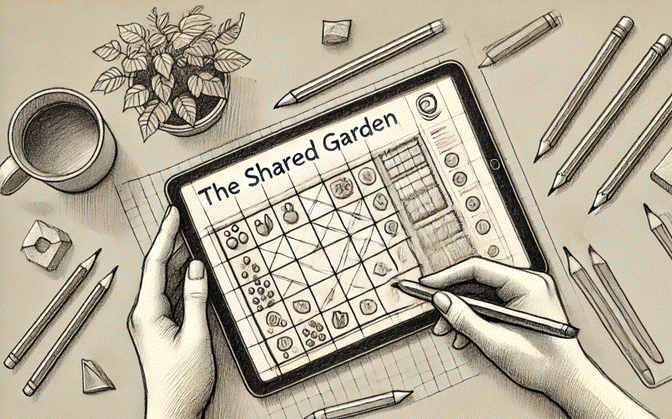
Early concept sketch for Scenario 2: The Shared Garden generated with DALL·E, edited with Adobe Photoshop
Description
The Shared Garden introduces learners to the collaborative side of urban micro-gardening by guiding them through the design of a small shared garden space. It focuses on negotiation, coordination, and plant compatibility, helping participants understand how community gardens succeed when people work together. This scenario builds social connection while teaching practical skills for planning and maintaining a communal green area.
General information
Scenario title: The Shared Garden: grow together, thrive together
Linked e-Toolkit module: 4, 5
Target audience: Unemployed, low-income, or marginalized urban dwellers; community centre groups; newcomers.
Duration: 20–30 minutes
Format: Hybrid (digital collaboration activity used alongside a workshop or group session)
Pedagogical framework
Learning objectives:
- Identify which plants can be grouped together based on needs (sunlight, water, companion planting).
- Plan a shared micro-garden layout that balances space, resources, and group roles.
- Recognize simple conflict-resolution strategies for shared spaces (e.g., dividing tasks, scheduling watering).
- Construct a maintenance plan for a communal container or raised bed.
Key concepts: companion planting, shared responsibility, soil health basics, water distribution, garden planning
Competence development:
- Collaboration & communication: Learners practise decision-making together and negotiating shared choices.
- Social inclusion: Supports interaction between diverse participants (e.g., young–old, newly arrived–local residents).
- Digital literacy: Using a simple drag-and-drop interface to co-design the garden layout.
The narrative
The hook (story/context):“You and your neighbours have decided to transform a neglected corner of your apartment courtyard into a shared micro-garden. Space is limited, water access is shared, and everyone has different needs and preferences. You must design a garden that works for everyone—and keeps the plants alive.”
The role
The community gardener: A member of a small group responsible for co-designing and maintaining a shared urban garden space.
The challenge
- Multiple residents want different plants, but resources (sunlight, water, soil quality) are limited.
- Some plants support each other; others compete or attract pests.
- Players must coordinate choices to build a balanced and cooperative mini-garden that reflects real community dynamics.
Gameplay mechanics & dynamics
Core mechanic: collaborative drag-and-drop garden planner
- Players work in pairs or small groups using a simple shared digital interface.
- They drag plants, water points, and compost bins onto a limited garden grid.
- Each choice triggers plant “needs indicators” (sun, water, spacing) that must be kept in balance.
Feedback loops
- Healthy combination: Plants glow green, soil improves, biodiversity icon increases.
- Poor combination: Icons shift to yellow or red, pests appear, or water stress indicators blink.
- Group conflict simulations: If players overlap roles or overload one area, a prompt appears:
“Two neighbours want to water at the same time – how will you solve this?”
Win state
A balanced shared garden layout that meets plant needs and distributes responsibilities fairly.
Reward: A printable “shared garden plan” that groups can use in real-life workshops.
Inclusion & accessibility strategy
- Low-literacy support: Icons for sun, shade, water, and plant compatibility; minimal text.
- Cultural adaptability: Plant options include both locally common species and culturally relevant herbs.
- Low-resource relevance: Encourages DIY solutions (reused containers, shared tools) and focuses on free/low-cost actions.
- Group-friendly design: Scenarios can be completed even with mixed reading levels or different digital skill levels.
Facilitator / educator classroom guidelines
Preparation:
- Set up the digital garden planner on shared tablets/laptops or print the grid for tabletop play.
- Organize learners into diverse small groups to support inclusion and cross-learning.
During play:
- Observe group interactions, offer guidance when discussions stall or when groups need help understanding plant compatibility.
- Prompt learners to explore trade-offs (e.g., “If you choose mint, what needs to change?”).
Debrief questions:
- “How did your group decide who does which task?”
- “What surprised you about plant compatibility?”
- “Did your group face disagreements? How did you solve them?”
Real-world call to action
Ask participants to identify one shared outdoor or indoor spot (in their building, neighbourhood, or community centre) where a mini-garden could be created. Encourage them to sketch a simple plan inspired by their game layout.
7.3. Game scenario 3: The Green Detective
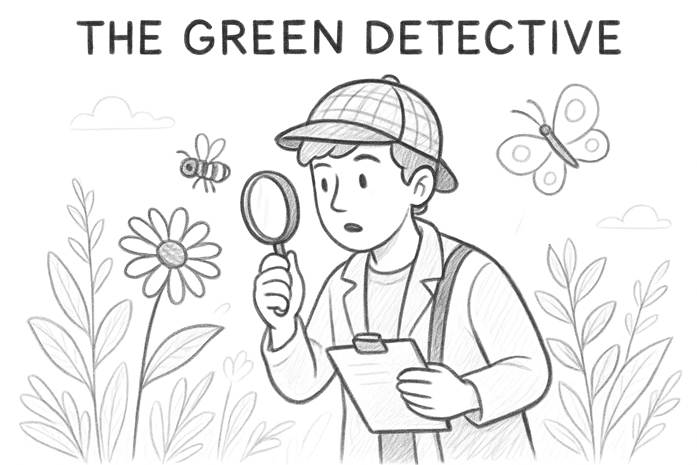
Early concept sketch for Scenario 3: The Green Detective generated with DALL·E, edited with Adobe Photoshop
Description
The Green Detective invites learners to step outside and observe the living world around them, turning everyday surroundings into a playful exploration of biodiversity. Through short missions and simple nature-spotting tasks, learners build awareness of insects, plants, and ecological interactions in their neighbourhoods. This scenario strengthens environmental literacy by encouraging curiosity, active observation, and mindfulness in urban spaces.
General information
Scenario title: The Green Detective: discover the nature around you
Linked e-Toolkit module: 4, 5
Target audience: Unemployed, low-income, or marginalized urban dwellers; adults with limited prior nature knowledge; learners in community centres seeking outdoor, experiential activities.
Duration: 30 minutes (flexible depending on outdoor access and seasonal conditions)
Format: Hybrid: digital mission list + real-world observation tasks (can be run outdoors, in a courtyard, on a balcony, or in a neighbourhood walk)
Pedagogical framework
Learning objectives:
- Identify common pollinators, beneficial insects, and simple edible plants.
- Observe and record biodiversity indicators (e.g., insect activity, plant variety, signs of soil health).
- Distinguish between common helpful species and common urban pests.
- Reflect on how biodiversity contributes to healthy micro-gardens.
Key concepts: pollinators, insects, biodiversity, edible wild plants, pest vs. beneficial species
Competence development:
- Environmental awareness: Learners become more tuned to nature in urban settings.
- Mindfulness & observation skills: Encourages slow looking and careful noticing.
- Digital literacy: Taking and uploading photos, using icons and species cards.
The narrative
The hook (story/context):“You’ve been recruited as a Green Detective in your neighbourhood. Hidden in plain sight are dozens of tiny clues – from visiting bees to edible weeds – that reveal the health of the local environment. Your mission is to spot them, record them, and help your community understand the nature that surrounds them.”
The role
The green detective: A curious urban resident who documents small biodiversity discoveries in their immediate environment.
The challenge
Complete a set of short, real-world observation missions such as:
- “Find three different pollinators.”
- “Spot a plant growing in a crack or wall.”
- “Identify one edible plant or herb growing near your home.”
- “Observe signs of insect habitat (water, shelter, food).”
Gameplay mechanics & dynamics
Core mechanic: Real-world observation quests
- Learners receive simple missions from a digital interface.
- They take a photo or make a quick selection from a visual list to confirm their observation.
- Missions vary by season and local context.
Feedback loops
- Species unlocked: A small card pops up when learners successfully record an observation.
- Encouraging messages: “You’ve spotted a bee!” “Great eye! That’s a hoverfly.”
- Progress bar: Shows biodiversity categories completed (pollinators, plants, habitats).
Win state
Completing all assigned missions for the day or session.
Reward: A personalised “local biodiversity snapshot” showing what they discovered, plus tips for supporting biodiversity on their balcony or community garden.
Inclusion & accessibility strategy
- Low-text missions: Icons and images guide learners, reducing reliance on reading skills.
- Culturally relevant plants: Missions include common, widely recognisable species from various European regions.
- Low-resource relevance: Tasks require no equipment – just observation and curiosity.
- Accessible pacing: Learners can complete missions at their own speed, supporting those with mobility or attention limitations.
Facilitator / educator classroom guidelines
Preparation:
- Introduce basic pollinator and plant identification using the e-Toolkit visual resources.
- Provide participants with access to the digital mission list before going outdoors.
During play:
- Accompany learners on a short walk or invite them to explore the outdoor space around the centre.
- Assist with photo-taking or species recognition for learners with lower digital confidence.
Debrief questions:
- “Which discovery surprised you the most?”
- “How can these species benefit your balcony or community garden?”
- “Did anything you found make you look at your neighbourhood differently?”
Real-world call to action
Ask learners to create a simple biodiversity-supporting feature at home – such as a small water dish for insects, a native herb pot, or leaving a patch of soil undisturbed for habitat.
7.4. Game scenario 4: The Exchange Market
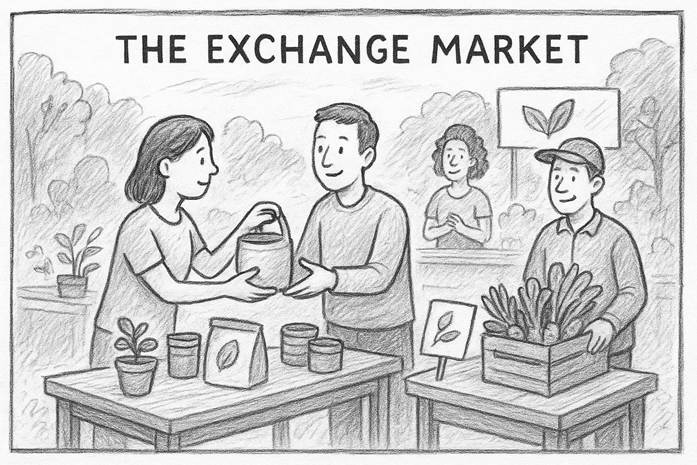
Early concept sketch for Scenario 4: The Exchange Market generated with DALL·E, edited with Adobe Photoshop
Introductory description
The Exchange Market introduces learners to the idea of sharing, trading, and supporting each other through low-cost, sustainable gardening practices. It highlights how community exchange systems can reduce waste, increase access to resources, and build social connections. This scenario helps adults experience fairness, reciprocity, and resourcefulness through playful decision-making.
General information
Scenario title: The Exchange Market: grow, share, and trade
Linked e-Toolkit module: 4 and 5
Target audience: Unemployed, low-income, or marginalized urban dwellers; adults who benefit from low-cost gardening approaches
Duration: 20–30 minutes
Format: hybrid (digital decision-making tasks + optional in-person exchange activity)
Pedagogical framework
Learning objectives:
- Identify which items or skills can be shared or exchanged in a community garden setting (seeds, compost, tools, time).
- Sort resources into categories such as “can share,” “can swap,” “can repair.”
- Plan a simple exchange strategy to meet their gardening needs with minimal cost.
- Evaluate the fairness and usefulness of different exchange offers.
Key concepts: seed saving, home made soil amendments, sharing economy, compost exchange, resource fairness, low-cost gardening
Competence development:
- Social skills: negotiating, asking for help, offering support.
- Financial resilience: understanding free and low-cost methods for starting or maintaining a garden.
- Communication skills: expressing needs and proposing trade options.
The narrative
The hook (story/context):“Your community garden group is preparing for the new season, but everyone has different needs and limited resources. One neighbour has extra seeds, another has homemade compost, another has time to help with watering. To get your garden started, you need to participate in the exchange market and trade wisely.”
The role
The resourceful gardener: someone who must combine creativity, fairness, and negotiation to gather what they need without spending money.
The challenge
Learners receive a list of needs (soil improvement, seeds, tools, starter plants) and must obtain them by choosing fair trades, offering their own items or skills, and balancing what benefits the group and their own garden.
Gameplay mechanics & dynamics
Core mechanic: choice-based trading system
- Players receive digital cards representing items or skills they can offer (e.g., 1 liter of compost, seed packets, watering help).
- They choose from exchange offers proposed by virtual neighbours.
- Trades affect a simple “fairness meter” and “garden readiness meter.”
Feedback loops
- Good trade: garden readiness increases; a friendly message appears (“great swap! you now have basil seeds”).
- Unfair trade: fairness meter drops; a hint appears (“this neighbour might feel left out – try a more balanced exchange”).
- Waste reduction bonus: trading reused containers or homemade compost earns extra progress.
Win state
Achieving full garden readiness with fair exchanges that benefit both the player and at least one virtual neighbour.
Reward: printable resource list, showing how to start a garden with near-zero cost using sharing-based practices.
Inclusion & accessibility strategy
- Low-literacy support: icons for items (seed packet, shovel, watering can), visual fairness meter, colour-coded offers.
- Low-resource relevance: emphasizes diy, reused materials, and social support instead of buying new items.
- Cultural adaptability: includes familiar herbs and common household materials from different regions.
- Accessible pacing: trades can be made slowly, allowing reflection and group discussion.
Facilitator / educator classroom guidelines
Preparation
- Prepare printed or digital “trade cards” with items commonly found in low-income households (jars, buckets, plastic bottles, food scraps, seeds).
- Optionally create a simple physical exchange table for hands-on practice.
During play
- Encourage learners to discuss why certain trades feel fair or unfair.
- Guide participants toward solutions that reflect real-life constraints (limited money, small space, reliance on community).
Debrief questions
- “Which items were easiest to trade? Which were hardest?”
- “How did you decide what was a fair exchange?”
- “What could you realistically share or swap with someone in your neighbourhood?”
Real-world call to action
Invite learners to bring one item or skill they could offer (a jar, seeds, knowledge, help) to the next workshop session for a real mini-exchange market.
7.5. Game scenario 5: The Story Garden
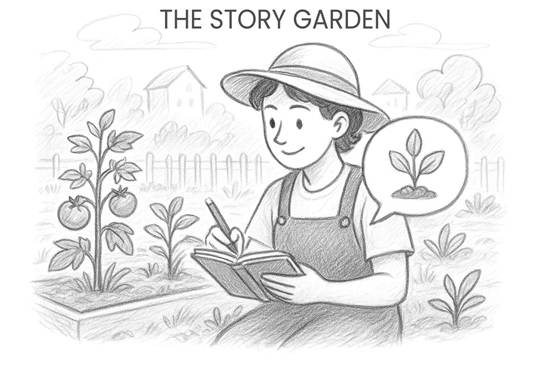
Early concept sketch for Scenario 5: The Story Garden generated with DALL·E, edited with Adobe Photoshop
Introductory description
The Story Garden invites learners to connect emotionally with their micro-garden by shaping a small narrative around the plants they choose, the care they give, and the transformations they observe. It turns practical gardening knowledge into a personal storyline that grows with them over time. This scenario strengthens reflection, creativity, and a sense of ownership by framing gardening as an evolving life story.
General information
Scenario title: The story garden: grow your narrative
Linked e-Toolkit module: 1, 5
Target audience: unemployed, low-income, or marginalized urban dwellers; adults who benefit from reflective and motivational learning
Duration: 25 minutes
Format: digital (simple story-builder with optional photo uploads)
Pedagogical framework
Learning objectives:
- Identify the needs, characteristics, and purpose of the plant they choose for their story.
- Construct a simple story that links gardening actions to plant development (sun, water, growth stages).
- Reflect on challenges or successes and connect them to real gardening experiences.
- Plan one small next step in their gardening journey based on the narrative they create.
Key concepts: growth stages, plant needs, seasonal rhythms, care routines, observation, reflection
Competence development:
- Self-reflection: understanding personal motivation and building emotional connection to learning.
- Storytelling skills: expressing experiences in simple narratives, beneficial for low-literacy learners.
- Motivation and resilience: turning setbacks into meaningful story moments.
The narrative
The hook (story/context):“every garden holds a story. In this scenario, you will create the first chapter of your own garden journey by choosing a plant, giving it a purpose, and describing how it grows under your care. Each task you complete unlocks a new part of the story.”
The role
The storyteller gardener: someone who grows both a plant and a narrative, using imagination and observation.
The challenge
Learners choose one plant (tomato, basil, mint, lettuce, or a houseplant) and build a simple three-part story:
- Chapter 1: “What am I growing?”
- Chapter 2: “What does my plant need?”
- Chapter 3: “How do they change over time?”
- Each chapter includes a small prompt or task connected to the e-Toolkit.
Gameplay mechanics & dynamics
Core mechanic: guided story-building
- Players select a plant card and answer short prompts.
- They can upload a photo, draw a simple shape, or choose from icons to illustrate each chapter.
- The story is automatically assembled into a simple illustrated page.
Feedback loops:
- New chapter unlocked: each correct or thoughtful answer reveals the next story segment.
- Positive reinforcement: gentle prompts such as “your plant loves this choice” or “great reflection.”
- Visual growth indicator: the plant illustration becomes a little fuller with each completed step.
Win state
Completion of the full three-chapter story and creation of a simple “garden diary page.”
Reward: downloadable story sheet (PDF) that learners can keep or add to during future workshops.
Inclusion & accessibility strategy
- Low-literacy friendly: uses icons, audio prompts, and optional drawing instead of writing.
- Emotionally supportive: encourages expression without judgment; mistakes become story moments.
- Low-resource relevance: story focuses on simple, inexpensive plants anyone can grow.
- Culturally adaptable: learners can choose culturally meaningful plants if relevant.
Facilitator / educator classroom guidelines
Preparation
- Provide printed or digital plant cards for learners to choose from.
- Introduce the idea of a “garden diary” or personal reflection.
During play
- Encourage creativity and reassure learners that stories do not have to be perfect.
- Help participants connect story moments to real gardening knowledge from the e-Toolkit.
Debrief questions
- “What part of your story felt most true to your own experience?”
- “How did your plant’s needs shape the story you told?”
- “Which next chapter would you like to write in real life?”
Real-world call to action
Invite learners to start a real “story plant” at home or in the community garden and document its growth weekly with notes or photos.
8. Next steps
These five scenarios can serve as prototypes to be developed and tested with adult learners. Feedback from these pilots will help refine the mechanics, visuals, and accessibility features before full integration into the InclusiGardens e-learning ecosystem. Through testing, we aim to measure not only user engagement but also actual behavioral change – proving that playful learning can cultivate real sustainability. By connecting gamification with real life actions, InclusiGardens turns micro-gardening into a shared, long-term journey toward greener cities!
References & Sources
Bates, Anthony William (Tony). 2022. “Emerging Technologies.” In Teaching in a Digital Age: Guidelines for Designing Teaching and Learning, 3rd ed. Vancouver, BC: Tony Bates Associates Ltd. https://pressbooks.pub/teachinginadigitalagev3m/chapter/8-7-emerging-technologies/.
Bradler, Annabelle M., and EVRgreen Studio. 2024. “Forest Garden.” EVRgreen Studio. https://evrgreenstudio.com/forestgardengame/index.html.
Carr, D., H. Taylor, R. Hunt, and T. Mejia. 2014. “Gamification and Adult Literacy.” Report of Literacy Link South Central’s Job Creation Partnership Project. Literacy Link South Central. https://web.archive.org/web/20170113205636/http://www.llsc.on.ca/sites/default/files/Gamification%20and%20Adult%20Literacy.pdf.
Desjardins, Richard. 2015. “Participation in Adult Education Opportunities: Evidence from PIAAC and Policy Trends in Selected Countries.” Background Paper for the Education for All Global Monitoring Report 2015. Paris: UNESCO. https://unesdoc.unesco.org/ark:/48223/pf0000232396.
Education Express. 2022. “What Does Co-Design Really Mean?” Education Express (blog), UTS. https://educationexpress.uts.edu.au/blog/2022/01/10/what-does-co-design-really-mean/.
Edyoucated. 2022. “The Power of Gamification in Continuing Education.” Edyoucated Blog. https://edyoucated.org/en-us/blog/gamification-in-continuing-education.
Electronic Platform for Adult Learning in Europe (EPALE). 2019. “Gamification in Adult Learning: Expectations vs Reality.” https://epale.ec.europa.eu/en/blog/gamification-adult-learning-expectations-vs-reality.
Electronic Platform for Adult Learning in Europe (EPALE). 2023. “Gamification in Adult Learning.” https://epale.ec.europa.eu/en/blog/gamification-adult-learning.
Electronic Platform for Adult Learning in Europe (EPALE). 2024. “Benefits and Tips: Gamification in Digital Learning.” https://epale.ec.europa.eu/en/content/benefits-and-tips-gamification-digital-learning.
Elsawah, Wafaa. 2025. “Exploring the Effectiveness of Gamification in Adult Education: A Learner-Centric Qualitative Case Study in a Dubai Training Context.” International Journal of Educational Research Open 9: 100465. https://doi.org/10.1016/j.ijedro.2025.100465.
Fantazir, Kirsten, and Murray Bartley. 2021. “Role-Playing Gamification Technologies with Adult Learners.” Imagining SoTL 1: 3–24. https://mrujs.mtroyal.ca/index.php/is/article/view/520.
GDL Project. 2023. “Gamification of Digital Learning.” https://gdl-project.eu/.
Kostas, Apostolos, George Koutromanos, and Ioanna Lagopati. 2025. “Gamification in Online Adult Learning: A Systematic Literature Review.” Journal of Information Technology Education: Research 24: 1–34. https://doi.org/10.28945/5549.
O’Donnell, Frances. 2022. “Gamification in Adult Education.” Teachnet (blog). March 28, 2022. https://teachnet.ie/gamification-in-adult-education/.
Por, Fei Ping, Christina Sook Beng Ong, Siew Keow Ng, and Arathai Din Eak. 2025. “A Bibliometric Analysis on Gamifying Adult Learning: Past, Present and Future Trends of Learner-Centered Pedagogies.” Interactive Technology and Smart Education 22 (1): 43–60. https://doi.org/10.1108/itse-11-2023-0226.
Šimko, Oliver. 2014. “Gamification – Creating Engaging Learning Communities.” Adult Education and Development 81. https://www.dvv-international.de/en/adult-education-and-development/editions/number-81/articles/gamification-creating-engaging-learning-communities.
Smith, Mark K. 2010. “Participation in Learning Projects and Programmes.” The Encyclopedia of Informal Education. https://infed.org/dir/welcome/participation-in-learning-projects-and-programmes/.
Watsjold, Bjorn K., Michael Cosimini, Paulius Mui, and Teresa M. Chan. 2022. “Much Ado about Gaming: An Educator’s Guide to Serious Games and Gamification in Medical Education.” AEM Education and Training 6 (4): e10794. https://doi.org/10.1002/aet2.10794.
Appendix: Selection of Erasmus+ gamification-related projects
| Project | Sector | EPR platform |
| The Power of Gamification | ADU | [link] |
| Games4You | ADU | [link] |
| GamifiedEd: Gamification in adult education | ADU | [link] |
| Gamification of eco-friendly habits in adult education | ADU | [link] |
| Social Inclusion Through Gamification in Education | ADU | [link] |
| Skills For Employment: Acquiring employment skills in adult education through gamification | ADU | [link] |
| Gaming in action – Engaging Adult Learners with Games and Gamification | ADU | [link] |
| EDU-GameBox | ADU | [link] |
| Learning through Gamification – Integration of the vulnerable groups | ADU | [link] |
| Preparing refugees and asylum seekers for European civic and democratic values, environmental protection and the use of digital tools through visual language and gamification | ADU | [link] |
| Improving adult education resources based on gamification, promotion of participation and collective management of the commons | ADU | [link] |
| Gamification Activities and Methods for the Elderly’s Support | ADU | [link] |
| Promoting the Transition to Active Life through Gamification and Game-Based Learning | ADU | [link] |
| AduGames | ADU | [link] |
| Improving adult digital literacy through innovative gamified blended learning | ADU | [link] |
| Digital education for adults and adult educators in e-government access through context-based gamified scenarios | ADU | [link] |